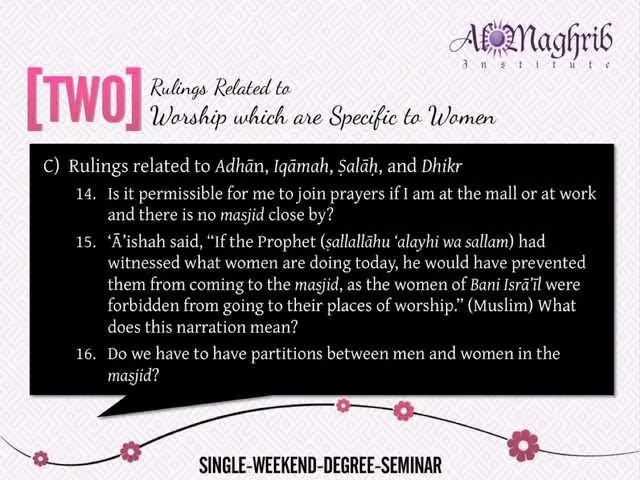
This study session covers Part 2 of Chapter 2 from the “Complicated” series on the fiqh of women’s issues, taught by Sheikh Waleed Basyouni. It addresses practical rulings related to women’s prayer (salah), including congregational prayer, carrying babies during worship, and the specific differences between men’s and women’s prayer.
Key Rulings on Women and Prayer
- Leading prayer: Women may lead other women in prayer and may also lead young boys who have not reached puberty. A young boy who knows the rulings of salah may lead adults in prayer
- Standing beside your husband: Women should pray behind men, even behind their own husbands, according to the consensus of Muslim jurists
- Carrying a baby with a dirty diaper: A mother is permitted to carry her baby during prayer, even if the diaper is soiled
- Women’s prayer lines: Women should stand close together without gaps, just as men do, to prevent gaps for Shaytan and to maintain full reward
- Praying Witr after Isha: Some women pray Witr after Isha, but this practice needs correction since Isha prayer replaces the need for a separate practice in this manner
“If a small area of her hair or neck becomes visible while going into sujood or rukoo, the salah is still acceptable. But if the person was unaware that a large body part was showing, the salah is also still valid.”
Practical Guidance for Women in Worship
The session also addresses whether women can pray in congregation (Jamaa) — it is encouraged but not obligatory for women praying alone. When women pray together, the imam may stand in the middle of the first row or in front, as Aisha (may Allah be pleased with her) used to lead women in prayer. Regarding people passing in front of a praying person, the sunnah is to use a sutra (barrier), and a child should be taught not to cross in front of someone who is praying.
Five Differences Between Men’s and Women’s Prayer
- Men must call the adhan and iqamah; women do not
- When the imam makes a mistake, men say “SubhanAllah” while women clap
- Men say “Ameen” out loud; women say it silently
- Men can lead both men and women; women cannot lead men in obligatory prayer
- Two men stand side by side, but a woman praying with a man stands behind him
These rulings demonstrate the beauty of Islamic jurisprudence in providing clear, practical guidance that honors both the spiritual equality and the unique circumstances of Muslim women in their worship of Allah.