
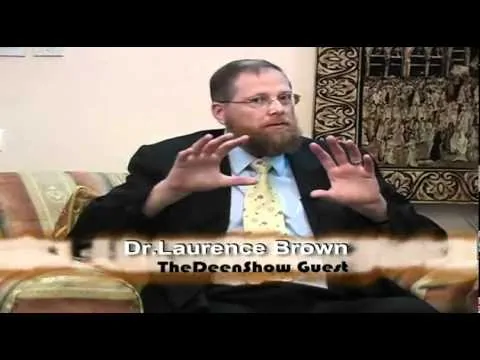
What does it take for a man who seemingly has everything — an Ivy League education, a flourishing career as an ophthalmologist, eight years of active U.S. Air Force service, and a picture-perfect family — to discover that none of it fills the deepest human need? For Dr. Laurence Brown, the answer came not gradually, but in a single, terrifying moment beside a hospital incubator, when a promise made to God in a prayer room changed the entire course of his life. A product of Christian-American ancestry dating back to 1677, Dr. Brown had lived as a self-sufficient atheist, navigating every challenge through intellect and sheer determination. But when his newborn daughter’s life hung in the balance and his worldly power proved utterly useless, something broke open in him — and what followed was a rigorous, years-long journey through the Abrahamic faiths that led him, irrevocably, to Islam.
A Father’s Promise and the Miracle That Demanded an Answer
When Hannah, Dr. Brown’s newborn daughter, was diagnosed with a coarctation of the aorta — a lethal narrowing of the heart’s main artery — he came face to face with the one thing his credentials could not overcome: helplessness. As Hannah’s lower body turned a dusky blue in the intensive care unit, starved of oxygen before his eyes, Dr. Brown walked to the hospital prayer room and offered what he described as “the prayer of the skeptic”: Oh God, if you are there, I need help. He made a sincere covenant with his Creator — if Hannah’s life were spared, he would seek out and follow the religion most pleasing to God. Within twenty minutes, he returned to find the medical team visibly shaken and quietly mystified. Hannah was going to be fine. She required no surgery, no medication. Before-and-after ultrasounds confirmed what no clinical explanation could fully satisfy: her defect had completely reversed. The doctors offered their reasoning, and Dr. Brown listened — standing there, knowing with quiet certainty that this was something else entirely. His promise had been heard. Now it had to be kept.
- Dr. Brown grew up in a non-practicing Quaker household and had lived as an atheist — organised religion had never been part of his identity or worldview
- Hannah’s coarctation of the aorta was a grave diagnosis: the condition typically requires repeated open-heart surgeries throughout childhood, with many children not surviving to adulthood
- Her complete recovery — confirmed by comparative ultrasound imaging — left the specialist medical team without a satisfying clinical explanation
- The experience shattered Dr. Brown’s lifelong self-reliance and awakened in him a profound awareness of his dependence on his Creator for the very first time
- He committed to an earnest, systematic study of the Abrahamic traditions — beginning with Judaism, then moving into Christianity — to honour the promise he had made before God
“I prayed this prayer, and I just have to believe that this was the hand of my Creator. I knew he had made good on his promise, and I had to make good on mine.” — Dr. Laurence Brown
The Theological Questions That Christianity Could Not Resolve
- The Trinity is absent from scripture: The word “Trinity” appears nowhere in the Bible. The doctrine was formulated three hundred years after Jesus, and its strongest textual evidence — a reference to the Father, Son, and Holy Spirit — was later established to be a marginal note added by a later scribe, not part of the original manuscripts. The clergy Dr. Brown consulted acknowledged this privately, yet continued to preach it as revealed truth from the pulpit
- Jesus never called himself the Son of God: In the New Testament, Jesus refers to himself as “the son of man” 88 times — not once does he explicitly call himself the Son of God. Passages cited in support of this claim are either demonstrable mistranslations or clearly metaphorical in context, distinctions the priests conceded when pressed but never addressed openly
- Jesus and Paul taught fundamentally opposing things: Jesus affirmed the absolute Oneness of God, upheld Old Testament law, and preached individual moral accountability. Paul cancelled the law, introduced the doctrine of inherited sin, and developed the theological scaffolding for the Trinity. These are not complementary positions — they are contradictions, and no congregation Dr. Brown visited could reconcile them with intellectual coherence
- The chain of prophethood pointed forward to a completion: Moses predicted three prophets to follow; John the Baptist and Jesus account for two. Jesus himself pointed to a final prophet yet to come. This thread — left unresolved and waiting within both Judaism and Christianity — found its fulfilment in the Prophet Muhammad ﷺ and in the message of Islam
How Islam Completed Every Question and Brought True Peace
“It wasn’t until I found Islam that all of my questions were answered, and it wasn’t until I found Islam that peace entered my heart — I realized that this was where all the pieces of the puzzle came together.” — Dr. Laurence Brown
After years of exhaustive study and the deepening recognition that no Christian tradition could fully accommodate his convictions, Dr. Brown turned to Islam — not out of desperation, but out of intellectual honesty and spiritual necessity. Reading the Holy Qur’an and Martin Lings’ landmark biography Muhammad: His Life Based on the Earliest Sources, he found that Islam answered every question he had carried and completed the very chain of divine revelation he had always intuitively believed in. The concept of Tawheed — the absolute, undivided Oneness of God — aligned precisely with what Jesus himself had taught. The prophethood of Muhammad ﷺ fulfilled the predictions of both Moses and Jesus, closing a circle that had remained open for centuries within the Abrahamic tradition. And when Dr. Brown began living among Muslims, he encountered something he had not anticipated: a community whose daily lives embodied the very values he had been searching for throughout his spiritual journey — softness of heart, generosity, modesty, truthfulness, and a sincere, unassuming submission to the Creator. As he put it simply, Islam was “life the way it’s supposed to be lived.”
Dr. Brown’s path to Islam is ultimately a story about what intellectual honesty looks like when it costs something real. He did not drift into faith — he earned it through years of rigorous questioning, honest scholarship, and the willingness to follow evidence wherever it led, even when that meant surrendering a familiar and comfortable identity. His experience speaks directly to those who carry deep spiritual values but cannot find a tradition that holds them completely — those who believe in God and His prophets, yet cannot accept doctrines that both reason and scripture challenge. Islam does not ask you to set aside your intellect. It invites you to use it fully, with sincerity and an open heart, trusting that the Creator who answered a sceptic’s prayer in a hospital prayer room has never — and will never — leave humanity without clear, accessible, and merciful guidance.