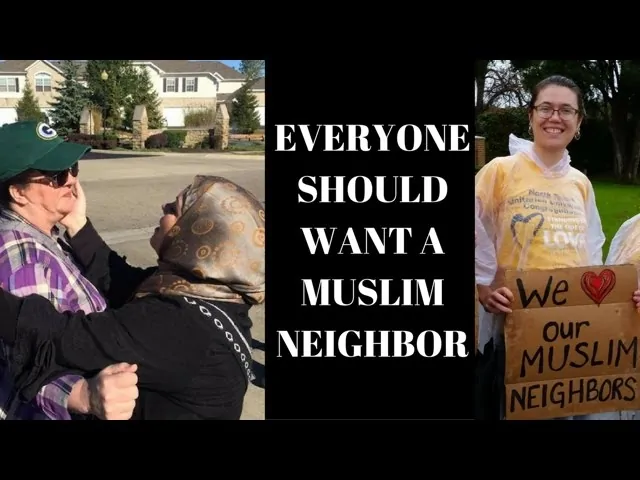
Despite being one of the most misunderstood faiths in the Western world, Islam produces communities that — by nearly every measurable standard — represent the best of what neighbourliness, civic contribution, and moral character can look like. In this episode of TheDeenShow, host Eddie sits down with William, a white American convert from Detroit whose lifelong search for fitra — the innate human inclination toward recognising the Creator — led him, after half a lifetime of struggle and seeking, to the clarity of Islam. His story is not unusual. Across America, men and women from every background are looking past the manufactured fear and finding something the data has long confirmed: practising Muslims are not a threat to their communities. They are the backbone of them.
What the Evidence Actually Shows About Muslim Communities in America
“Honestly, if a Muslim family moved next door to you, you would be the happiest person in the world. First of all, the chances of your kids getting in trouble just went way down — because the Muslim Community has the lowest crime rate, the highest entrepreneurship, the highest educational attainment for women in the country. They are the model American community.”
— Van Jones, political commentator
- Lowest crime rates of any community demographic — practising Islam instils accountability, restraint, and a profound sense of moral responsibility before Allah
- Highest educational attainment for women in America — directly contradicting the narrative that Islam suppresses women’s potential
- Highest entrepreneurship rates — rooted in an Islamic ethic of honest trade, hard work, and contribution to society
- Deep American roots — from enslaved African Muslims who preserved their Deen across generations, to Arab-American workers who helped build Detroit’s auto industry and the American middle class
- Historical recognition — the Kingdom of Morocco was the first nation to formally recognise the United States; the Founding Fathers studied the Quran and understood Islamic governance
- Multigenerational citizenship — Muslim Americans are first, second, fifth-generation contributors to this nation, not a foreign import
This is not abstract theology — it is lived reality, and William traces it through his own family history. His Lebanese grandfather arrived in Detroit over a century ago, worked on the Ford assembly line, and then, consistent with a deeply Islamic spirit of enterprise, started his own business. Arab-American Muslims were foundational to the very industry economists credit with building the American middle class. Islam, far from being alien to America’s story, has always been part of its fabric. The word “Allah” — which causes so much unnecessary alarm — is simply Arabic for God; Jesus himself, speaking Aramaic, would have said Allaha. A Muslim is one who submits their will to God, just as the Lord’s Prayer itself declares: “Thy will be done.” To submit to the Creator — not to a statue, a celebrity, a political ideology, or a grave — is the most natural act a human soul can perform. It is Islam.
Answering the Deepest Questions: Purpose, Spirituality, and the Path Through the Noise
In a country where one in ten people are on antidepressants, where suicide is the second leading cause of death among those aged ten to twenty-four, and where 5% of the global population consumes 80% of its cocaine, the crisis of spiritual purpose is not a fringe concern — it is a public emergency. People numbing themselves with alcohol, painkillers, and screens are, at their core, trying to fill a void that material life cannot touch. William speaks directly to this: the two halves of human existence — the physical and the spiritual — both need to be nourished, and when society forgets the spiritual dimension, everything begins to break down. The misconception that Islam demands blind obedience or seeks top-down social control is the opposite of the truth. The earliest Quranic revelations were about Iman — faith — about accountability, and about each person’s direct, unmediated relationship with their Creator. The Prophet Muhammad, peace and blessings be upon him, did not come to subjugate; he came to embolden humanity with guidance and to free people from the worship of anything other than Allah. A true “fundamentalist” — in any faith — is, by definition, a good, kind, loving, and contributing person. Those who call themselves fundamentalists while practising hatred have simply misunderstood the fundamentals.
“I looked at the Deen, I looked at the Quran and the Sunnah, and I didn’t judge based on people. When I looked at the reality of humankind — I studied the history, the anthropology — the Quran answers all of it throughout time. It is eternal.”
— William, American convert to Islam
For anyone standing at the edge of this path — curious but cautious, drawn but afraid — the advice William offers is both simple and transformative: go directly to your Creator. Sincerely ask, without intermediary and without pretence, for guidance. Allah answers that du’a. You do not need a religious institution to exploit you, a tradition to confuse you, or a crowd to validate you — you need only the honesty to admit you are searching, and the sincerity to ask the One who fashioned you to show you the way. The fact that hundreds of millions of dollars are reportedly spent every year by organised interests to defame Islam and its Prophet, peace be upon him, is itself a kind of testimony: you do not pour that level of effort into destroying something that poses no challenge to the forces of confusion and moral decay. Look at the Deen on its own terms. Read the Quran. Visit a mosque. Have a real conversation with a practising Muslim neighbour — and discover what Van Jones, William, and countless others across America have found: that the message at the heart of Islam is as old as humanity and as urgent as today — worship the Creator alone, do good, care for those around you, and prepare, with gratitude and hope, for the life that comes after this one.