The question of whether Jesus (peace be upon him) is God has occupied theologians, scholars, and sincere seekers of truth for centuries. For Muslims, the answer is rooted not in rejection of Jesus, but in deep reverence for him as one of the mightiest Messengers of Allah. Yet when we examine the very scriptures Christians rely upon, a compelling case emerges that contradicts the doctrine of his divinity from within those texts themselves. This episode of The Deen Show explores that contradiction with precision and care, drawing on Biblical passages, historical scholarship, and the timeless clarity of Islamic faith and guidance.
A Weary, Sorrowful, Thirsty “God” — What the Gospels Actually Say
One of the most striking arguments in this discussion centres on the distinctly human qualities attributed to Jesus throughout the Gospels — qualities fundamentally incompatible with the nature of an all-powerful, self-sufficient Creator. The transcendent God of Abraham does not tire, hunger, or despair; yet the Biblical accounts repeatedly describe Jesus in these very terms, preserved in the canonical texts that Christians themselves hold sacred:
- Weariness and thirst: “Jesus therefore being wearied with his journey, sat thus on the well.” (John 4:6) — a scene of exhaustion that no monotheist would ever ascribe to God Almighty.
- Sorrow and anguish: “He began to be sorrowful and very heavy… my soul is exceeding sorrowful, even unto death.” (Matthew 26:37–38) — deep emotional distress incompatible with divine transcendence.
- Groaning and grief: Multiple Gospel accounts describe Jesus weeping, groaning, and expressing anguish — fully human responses to human circumstances, not attributes of the Eternal.
- Physical force and anger: Jesus fashioning a whip of cords and driving merchants from the Temple (John 2) — a powerful act of righteous zeal, but not indicative of divine omnipotence.
- Doubtful authorship at the source: The Gospel of John — the very text most relied upon for Trinitarian arguments — was disputed even in the second century CE. The Encyclopaedia Britannica records scholarly acknowledgement that it was composed with a theological agenda, not as eyewitness testimony.
“The likeness of those who take false deities as protectors other than Allaah is the likeness of a spider who builds for itself a house — but verily, the frailest of houses is the spider’s house, if they but knew.” (Al-‘Ankaboot 29:41)
Two Thousand Years of Waiting — The Unfulfilled Prophecy of Jesus’s Return
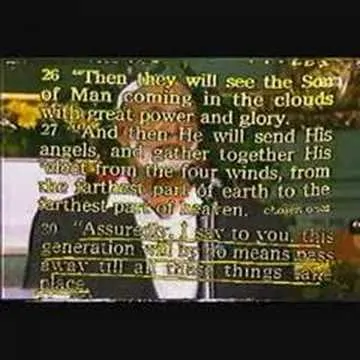
The discussion turns to one of the most rarely confronted problems in Christian theology: the prophecy of the imminent return of Jesus, delivered in unambiguous terms to his own generation, that has gone unfulfilled for over two thousand years. In Mark 13:26–30, Jesus declares that “this generation” would not pass away before seeing the Son of Man coming in the clouds with great power and glory. In Matthew 10:23, disciples are told they will not finish going through the cities of Israel before he returns. These were not vague metaphors — they were understood literally and urgently by those who heard them. The historical consequences have been devastating: early followers fled persecution city to city awaiting a return that never came; modern denominations like the Jehovah’s Witnesses — who build no permanent institutions precisely because they believe the end is perpetually imminent — set and abandoned specific dates including 1914 and 1918, watching congregants sell properties and upend their lives in a frenzy that dissolved into nothing. Spirituality built on unmet expectations is not divine guidance — it is human hope mistaken for prophecy.
- Mark 13:30: “This generation will by no means pass away till all these things take place” — the generation of 1st-century Judea is long gone.
- Matthew 10:23: The return promised before the disciples finished touring Israel’s cities — never fulfilled in their lifetimes.
- Repeated failed predictions: From the early Church to modern movements, date-setting has repeatedly led communities into spiritual and material ruin across 2,000 years.
- A faith built on expectation: When the emotional power of “any moment now” is the engine of belief, it replaces the stable, purpose-driven guidance that true faith in Allah provides.
Adam, Israel, and Solomon Were Also Called “Son of God” — The Title Is Not Unique
“Jesus said, ‘Do not hold on to me, for I have not yet returned to the Father. Go instead to my brothers and tell them, I am returning to my Father and your Father, to my God and your God.'” (John 20:17)
Perhaps the most clarifying lens in this entire discussion is the Biblical use of the phrase “son of God” itself — a title that, within the scriptural tradition Christians claim to uphold, is applied far more broadly than Trinitarian doctrine admits. Luke’s genealogy traces Jesus through Adam, who is also called “the son of God” (Luke 3:38). Exodus 4:22 declares Israel to be God’s firstborn son. Hosea 11:1 speaks of God calling “his son” out of Egypt, referring to the Israelite nation. Solomon is named God’s son in 1 Chronicles 28:6. John 1:12 extends the title to all who believe, and Matthew 5:9 promises that peacemakers “will be called sons of God.” If Adam, the nation of Israel, and Solomon all share this title, then the phrase carries a metaphorical meaning — the righteous servant honoured by God — not a literal claim of divine parentage. And in John 20:17, Jesus himself resolves the matter plainly: he distinguishes himself from God, calls God “my God,” and places his disciples in the same relationship to the Father that he holds. Islam does not ask us to diminish Jesus — it asks us to understand him truthfully, as a noble Prophet and Messenger whose mission of pure tawheed was obscured by texts compiled long after his time. The spirituality, purpose, and guidance that Islam offers is one of uncompromised clarity: one God, no partners, no contradictions. That is the faith of Jesus himself, and it is the faith that remains.