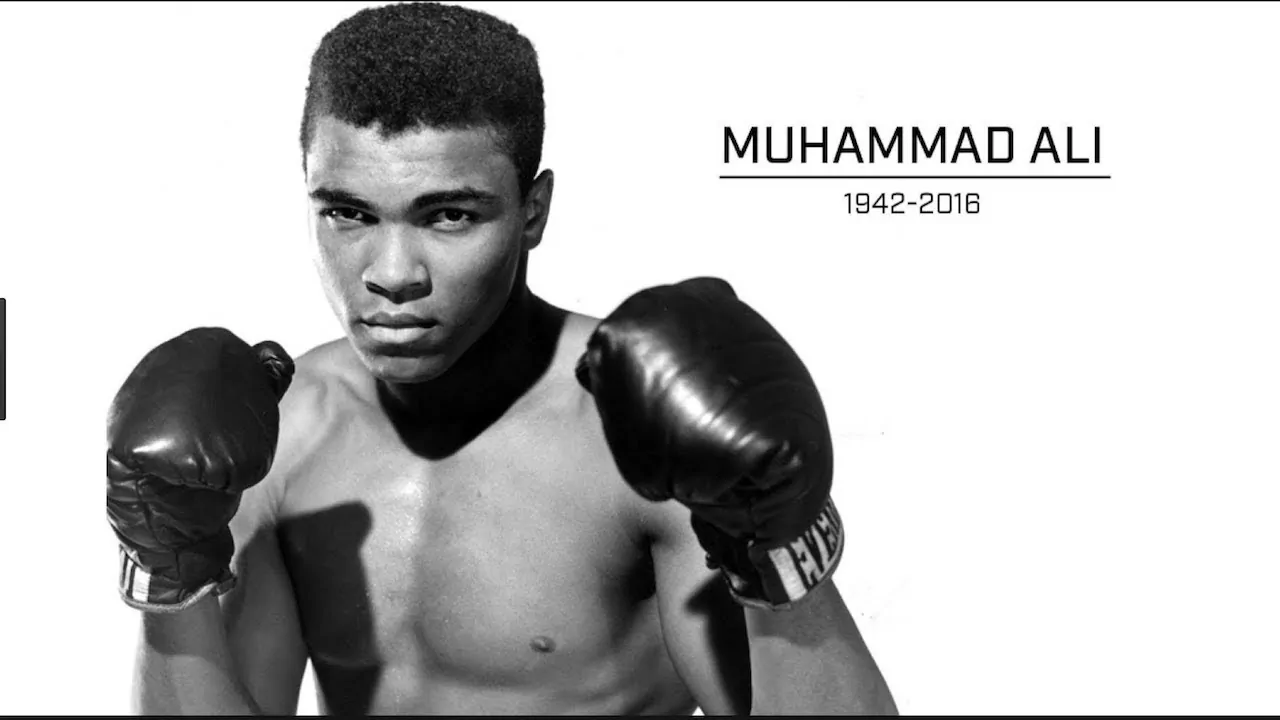
When an elderly man traveled from Tanzania to the United States with his grandson — flying first to Chicago, then across the country to Los Angeles, riding in taxis with a newspaper photograph of a house, carrying a humble Big Mac as a gift — all in search of one man, it says everything about what Muhammad Ali meant to the world. Ali was not merely the most celebrated heavyweight champion in history; he was a symbol of faith, spiritual courage, and human dignity that transcended borders, languages, and generations. Now, New York Times best-selling author Jonathan Eig has produced the definitive biography of this towering figure — drawing on more than 500 interviews, thousands of pages of previously unreleased FBI files, and deep access to Ali’s three surviving wives, his brother Rahaman, and the key people who shaped his extraordinary life. What emerges is a portrait not just of a boxer, but of a believer navigating the tensions between fame, failure, faith, and the fierce hope of paradise.
A Generous Heart: The Islam That Lived Behind the Headlines
That Tanzanian grandfather and his grandson did find Ali — in the mid-1990s, when he was largely out of the public eye, moving slowly, speaking softly, already battling the early effects of Parkinson’s syndrome. Rather than signing an autograph at the door, Ali welcomed them inside, made them sandwiches, ate the Big Mac they had brought as an offering, spent the entire afternoon telling stories and performing magic tricks, and then personally drove them to their motel in his Rolls-Royce. His manager Larry Kolb, who witnessed every moment, asked Ali afterward why he had given so much of his day to two strangers. Ali’s answer was rooted entirely in his Islamic faith and his deeply felt belief in the divine accountability every soul will one day face:
“I believe that there’s a tallying angel — an angel who’s counting all of your good deeds and all of your bad deeds. I’ve done a lot of bad things in my life. I’ve not always been a good husband, not always a good father. I’ve made a lot of mistakes, and this is my time to make up for those mistakes and to do more good deeds so that I go to paradise.”
- Deep belief in divine accountability: Ali lived with a vivid awareness that every deed is recorded — and an equally vivid fear of the Hellfire, which he described as placing your hand on a burning frying pan for millions of years.
- Radical generosity toward people: He routinely refused to use back entrances at events, insisting his car be brought to the front so he could spend time with ordinary people — often making himself late for his next appointment just to connect with those who loved him.
- Humility beneath the bravado: The same man who declared “I am the greatest” privately acknowledged his sins, his failures as a husband and father, and his urgent need for Allah’s mercy and forgiveness.
- Islam as a complete way of life: He rose at 4:30am every morning, performed wudu, put on his white robe, and prayed five times a day — a spiritual discipline he traced directly to the defeats that followed his moments of arrogance before Allah.
- A peacemaker and ambassador of understanding: He traveled to Pakistan, Afghanistan, and across the Muslim world, urging both Muslims and Americans to build bridges of mutual understanding — long before that mission became an urgent global necessity.
From Cassius Clay to Muhammad Ali: A Faith That Deepened in the Silence
Ali’s journey to Orthodox Sunni Islam was neither linear nor simple, and Eig’s meticulous research illuminates its full, remarkable arc. He entered Islam through the Nation of Islam, drawn as much by its message of Black dignity in a racially segregated America as by its spiritual claims. After Elijah Muhammad’s death, it was Elijah’s own son Wallace D. Muhammad who guided Ali — and thousands of others — toward the pure teachings of the Quran and Sunni Islam, a transition Ali made with full conviction. When Louis Farrakhan later visited Ali’s home and asked him to rejoin the rebuilt Nation of Islam, Ali refused firmly; he had found real Islam and would not turn back. In his post-boxing years, stripped of the voice that had once electrified millions, Ali sat silently for hours at the feet of renowned imams, transcribing Quranic verses and Islamic texts by hand into notebooks — because writing helped his mind absorb what his eyes struggled to hold. He also loved gathering people around him and teaching — comparing the Quran to the Bible, inviting curious sports fans back to his hotel room for hours of discussion about faith, purpose, and the oneness of the Creator. Eig’s research reveals a harrowing physical toll alongside this spiritual growth: working with Compubox punch-tracking data, he estimates Ali absorbed over 200,000 punches across his entire career, a cumulative damage that gradually silenced the most electric voice in sports — yet even in that silence, what remained was a man luminous with spiritual purpose and sincere devotion.
“Surely I have turned myself to Thee, O Allah, trying to be upright, to Him who has originated the heavens and the Earth… Surely my prayers, my sacrifices, my life and my death are all for Allah, the Lord of all the worlds.”
The story of Muhammad Ali, as illuminated by Jonathan Eig’s compassionate and rigorously researched biography, is not ultimately a story about boxing. It is a story about what it looks like when a human being — flawed, famous, and fallible — turns sincerely toward his Creator and spends the remainder of his life striving to earn His pleasure. His journey from the Nation of Islam to Orthodox Sunni Islam mirrors the path of many who encounter the pure, uncorrupted message of the Quran and recognize in it a guidance no cultural nationalism or political movement can provide. His generosity was not performance; it was sincere worship. His humility was not weakness; it was the hard-won wisdom of a man who had been handed everything the world prizes — wealth, fame, global adoration — and understood that none of it would carry any weight at the moment of reckoning before Allah. For anyone seeking to understand how Islam shapes character, purpose, and the deepest meaning of a life, Muhammad Ali remains one of the most powerful living testimonies of the modern era — proof that guidance can reach the most famous man on earth, and that the greatest victory any soul can win is not in the ring, but in returning, again and again, to Allah with a humble and repentant heart.