Surah Luqman opens with a declaration that sets the tone for everything that follows: the Quran is not merely a book of rituals but a living, breathing source of wisdom — al-Hikmah — revealed as a guide and mercy for those who truly seek to live with purpose and faith. These opening verses make clear that guidance is not a passive inheritance but an active pursuit, anchored in prayer, Zakat, and unwavering certainty in the Hereafter. Yet the surah does not romanticise this journey; it immediately draws a stark contrast between the believer who receives the divine word with an open heart and the one who trades the verses of Allah for idle distractions and mockery — a warning as urgent in our age of endless entertainment and spiritual noise as it was at the time of revelation, reminding every Muslim that heedlessness has its own devastating consequences.
Creation, Gratitude, and the Contrast Between a Guided Heart and a Heedless One
The early verses of this blessed surah ground the believer in the grandeur of Allah’s creation — heavens without pillars, mountains set firm in the earth, rain sent down to cause every noble plant to grow — as undeniable signs of divine power that leave no rational space for polytheism. This majestic cosmic backdrop is the very context in which Allah bestows upon Luqman al-Hikmah, and the first lesson accompanying this gift is shukr: gratitude. Recognising the blessings of Allah, from the universe stretched above us to the spiritual guidance placed within our hearts, is not mere etiquette — it is the foundation of a life lived in alignment with one’s purpose as a servant of the Creator. Those who receive the Quran and turn away in arrogance, behaving as though there were deafness in their ears, are in sharp contrast to the Muhsinun — the doers of good — upon whom these verses shower guidance and mercy in this life and the promise of gardens of delight in the next.
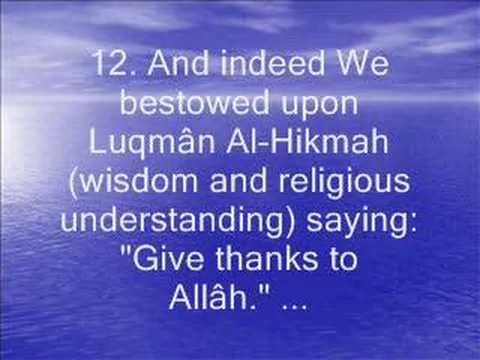
“And indeed We bestowed upon Luqman al-Hikmah (wisdom), saying: Give thanks to Allah. And whoever gives thanks, he gives thanks for the good of his own self. And whoever is unthankful, then verily, Allah is All-Rich, Worthy of all praise.” — Surah Luqman 31:12
- The Quran is described as guidance and mercy specifically for the Muhsinun — those who establish prayer, give Zakat, and hold firm certainty in the Hereafter
- Those who purchase idle talk to mislead others from the path of Allah, or who turn away in arrogance when His verses are recited, face a humiliating and painful punishment
- The heavens, mountains, rain, and every living creature are signs pointing to the oneness and incomparable power of Allah — making all forms of polytheism not merely wrong but a manifest and inexcusable error
- Gratitude is the first and foundational lesson of true wisdom; it begins with honestly acknowledging one’s complete dependency on the Creator for every blessing, seen and unseen
- For the believers who do righteous deeds, the promise of Paradise is not conditional speculation — it is the firm and truthful promise of Allah, Al-Aziz Al-Hakim, the All-Mighty, the All-Wise
Luqman’s Seven Counsels: A Timeless Blueprint for Faith, Character, and Spiritual Excellence
The heart of this surah is the direct speech of Luqman to his son — a series of profound, interconnected counsels that together form one of the most complete frameworks for Islamic character and spiritual development found anywhere in the noble Quran. He begins where all righteousness must begin: with Tawheed, the absolute and uncompromised oneness of Allah, warning that associating partners with Him is the greatest of all wrongs, a zulm azeem. He then turns to the rights of parents, honouring with extraordinary tenderness the mother who carried her child through weakness upon weakness, before establishing the crucial boundary that no obedience to creation overrides obedience to the Creator. He moves next to the awe-inspiring reality of divine accountability — no deed, even if as weightless as a mustard seed hidden deep within a rock or scattered across the heavens, escapes the knowledge of Allah — and uses this truth not to frighten but to liberate, encouraging his son to live with complete integrity even when no human eye is watching. His counsel then builds toward the pillars of righteous action: establish prayer as the connection to Allah, enjoin what is good and forbid what is evil as responsibilities to the community, and bear with patient endurance whatever trials befall you, for this is the way of those determined in their spiritual path. And finally, Luqman addresses outward conduct and character with precision — warning against the poison of arrogance in one’s gaze and swagger in one’s walk, and advising moderation of pace and lowering of the voice, since the most disagreeable sound in all of creation is the braying of one who forgot their station before Allah.
“O my son! If it be anything equal to the weight of a grain of mustard seed, and though it be in a rock, or in the heavens or in the earth, Allah will bring it forth. Verily, Allah is Subtle, Well-Aware.” — Surah Luqman 31:16
Surah Luqman, in just nineteen verses, presents a complete and radiant vision of what it means to be a Muslim of genuine faith and noble character. It speaks to every parent carrying the weight of raising children in an age of distraction and moral confusion, reminding them that the most enduring gift they can offer is not wealth or status, but the living transmission of wisdom — the wisdom of Tawheed, gratitude, accountability, prayer, and humility before Allah and His creation. It speaks to every individual navigating a world that rewards arrogance and rewards noise, offering instead the timeless model of a man whose name the Quran immortalised not because he was a prophet or a king, but because he was wise, grateful, and wholly devoted to guiding those in his care toward the pleasure of their Lord. These nineteen verses are a compass for every believer who seeks to walk through this world with purpose and sincerity — to stand with patience in adversity, to lower the gaze from pride, and to return to Allah having strived, however imperfectly, to embody the counsel that has echoed through centuries of Islamic spirituality and faith.